About Me

My photo
Diagnosed at 39 with Stage IV IDC breast cancer, grade 2, metastatic to the liver, and ER/PR+ and Her2-negative.

Monday, October 13, 2014

October 13: Metastasis is an Ugly Word


It's October 13th. Today is National Metastatic Breast Cancer Awareness Day. We get one whole day out of the entire pink month of October. One day. And that's a day people try to co-opt for bogus Facebook games that do nothing to spread awareness or raise funding for metastatic disease.
Today is the entire sum of this month's worth of blog entries, so instead of soapboxing on any issues I've covered, or will be covering in the coming days, I'm doing something special.

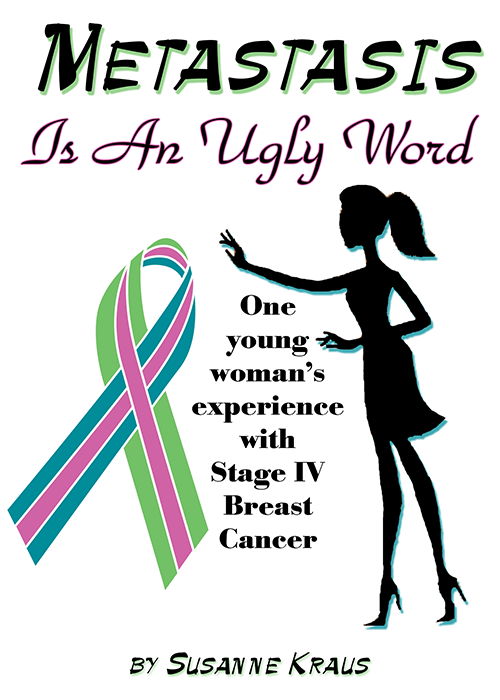
I'm sharing an excerpt from my memoir, Metastasis is an Ugly Word, when I first learn that the so-called cyst I thought I had was actually cancer, back in the days when I was still blinded by the pinkwashing of the disease.

*******

When I went to the Family Health Services clinic to have the cyst drained, the doctor examined it, and refused to proceed. She said it felt too solid, and if it was a cyst, it would be a more involved task to drain it than she was equipped to handle. She gave me a referral to a surgeon, which terrified me.

Not because I was worried that it might be cancer, but because I was worried about how I was going to afford that. I was thirty-nine years old, still more than six months away from qualifying for Every Woman Matters. Then she told me that wasn't true. I had an actual lump, it didn't matter how old I was. I qualified for that reason.

I was flabbergasted. I told her I'd never heard that, I'd looked into the program before, that I'd never received the impression it was accessible to me before the age of forty, lump or no lump.

"I know," she told me.

That made me angry. But what was done was done. I was there, and I would be able to see a surgeon to get a biopsy, and I would be covered under the program. No use in looking back and being angry about what might have been. Just another appointment to work into my mostly-free schedule.

I just let Karen, my Human Resources contact at work, know I'd not be coming in that day, as I was still on light duty per worker's comp because of my wrist. Most of my time at work was spent doing nothing but sitting with a certain resident who needed a one-on-one caretaker pretty much around the clock. Although I wasn't medically cleared to physically assist him if he needed to go to the bathroom, I could free up the other CNAs to work the floor and stay with him and make certain he didn't try to stand on his own.

By now, it was November 12th, and once more I'd waded through a world where everything was flooded with pink ribbons everywhere. If you didn't have Awareness about the Pink And Beatable Disease Of Women, you lived under a rock in the middle of nowhere. But I was still too young to worry about breast cancer. Besides, there was no history of it in my family to my knowledge at the time. GI tract cancers were a different story, but I had no symptoms for one of those either, and aside from an injured wrist, I was strong and healthy.

The day for my appointment came, and I went to the surgeon's office at Bryan West Hospital. When she did the biopsy, the tissue proved to be solid, not a cyst. Either the surgeon was a remarkably good actress, or she too wasn't terribly concerned about the possibility of cancer. After all, eighty percent of breast lumps are benign, especially for women in their thirties into their forties. Still, the biopsy sample was on its way to pathology, and the office would contact us once they had the results.

A week went by, and every day while sitting with the resident at work, I would pull out my phone and check the patient portal website I was given at the surgeon's office and look for results. The more I checked the site, and the longer it went by without an answer, the more anxiety I felt. It chewed on me enough that several coworkers and residents noticed my increasing agitation, and asked me what was wrong. To the residents, I simply said I was just thinking about something at home, and to my coworkers, I admitted the truth. I had a biopsy on a breast lump.

Saying it made it real, saying it brought in dark and scary feelings of panic. What if was cancer? What would I do? How could I afford it? It couldn't be cancer, we couldn't afford it, I'd die from not being able to afford the treatments, didn't that happen all the time? Why wouldn't they just post the result, why was it taking so long? I was going to load the page, and any minute now, it was going to tell me what the results were, and they would be benign and I'd laugh at myself for being so paranoid. Just another possible serious medical issue that turns out to be nothing at all.

I was already on Ativan for occasional anxiety attacks, and I took more of it now. I couldn't sleep. I was a bundle of nerves inside and working overtime to keep the nerves concealed. At night, I distracted myself with reading Watership Down for the umpteenth time, while in the back of my mind wondering if this might be the last time I'd ever get to read the book. No, that was silly. It wasn't cancer.  It was going to be fine.

I was sure there would be results posted on Friday, but there was nothing. The weekend rolled by in silence, and I was even more certain there would be something on Monday. Again, nothing. On Tuesday, a full week after the appointment, Jen called the office. My stomach twisted into horrible knots while I tried to make out what was going on just from her end of the conversation.

I couldn't stand it any longer.

"Is it cancer?" I whispered, twisting my fingers around each other.

She nodded.

My world dropped out underneath me and a cold wave of terror flushed every nerve. I started to panic and she shushed me, still trying to listen to what the doctor was saying on the other end.

November 19, 2013, I entered the New Normal.

The New Normal was a world that had cancer.

It's Cancer. Cancer. Cancer.

I was sure it was some horrible dream. I was in full-blown panic, our roommate came to see what was wrong. I was hysterical. The tests had to be wrong. No, it wasn't cancer. It was supposed to be something easily removed. It wasn't cancer. I couldn't have cancer. Cancer meant I was dying, no no no no this wasn't happening!

It wasn't that I didn't think breast cancer was easily treatable, that there wasn't a cure. As far as I knew, that was the case. But the money! Where would we get the money for the treatment that would save me? That is why I panicked. How were we going to afford this? I was going to die from a treatable disease, just like so many other Americans who couldn't afford health care. What were we going to do?

The surgeon said it was Invasive Ductal Carcinoma. It was the most common kind of breast cancer, easily treated. Easily treated. I'd be fine. Jen talked me down out of the panic attack, I was going to see an oncologist at the Southeast Nebraska Cancer Center on the 22nd, it was all still covered under Every Woman Matters, it was going to be fine.

I remembered the insurance I purchased in July of that year, and the cancer coverage, thinking of my resident who'd passed from colon cancer, thinking of my grandmother who passed from pancreatic cancer, not thinking at all of a cancer that no one in my family I was directly related to by blood had experienced. Or at least, that is what I knew at this point. I'd either never known or I had forgotten that my great-grandmother on my mother's father's side had breast cancer when she was younger.

I got on the computer and went to Facebook, looking to see if Angela, a friend of mine who does the schedules at work was online. She was. I asked if she was at the facility and when I got a confirmation that she was, I asked her to stay there. I needed to come in and it was big.

I grabbed the paperwork, planning to talk to HR about what I needed to do to get that insurance, and went to work. I didn't think about cancer, I focused on driving that mile and ran inside.

I told Angela, and the first thing she did was hug me, then grab my wrist and drag me to the office next to hers, the HR office. That's when I found out Karen herself was seven years out from a breast cancer diagnosis. I was with people who understood the panic I was desperately fighting and the relief of being understood, of being with people who had dealt with it and were okay, I broke down crying as the worst of the fear died down.

Karen said she'd come with me to the oncology appointment on Friday. Angela made certain I understood that I was not to worry about money. Declare bankruptcy if needs be, but the important thing was to focus on fighting. Not on worrying about what it was going to cost. Money wouldn't replace my life.

I had an appointment upcoming the following week to do surgery on my wrist, since it was healing too slowly for our liking. I was still on light duty, and the next few days of work were spent mostly getting told I was going to be fine, and talking with the former director of nursing, who had stage IV breast cancer. It was going to be fine.

I was going to be fine.

I could beat this thing. It was curable. It was just a bump in the road, I'd be fine, this would be cured, I would be cancer-free and back on track with the job I loved.

It was still terrifying though. But I knew that my outlook had some input on my chances for survival, regardless of the disease. People who give up in defeat do worse overall than those who keep a positive nature. I worked with that every day, I saw it in action, I knew this. So I knew I couldn't let fear and anxiety win.

I behaved in the manner I wanted to feel. I projected the kind of positive outlook I wanted to have. I acted far more confident than I felt, and I refused to allow the fear a foothold. Every time I started to panic, I would stop and recite the Litany Against Fear from Frank Herbert's Dune until I calmed down. As time went by, I found myself having to recite it less frequently.

"Make believe you're brave, and the trick will take you far." That line from the Rodgers and Hammerstein musical The King and I was true.

I could do this thing.


Sunday, October 12, 2014

October 12: Don't Play Games With Me

I ranted about this last month, but here it is again. You know the games I'm talking about. The inboxer messages that implore you to forward them to all the women on your friendslist, post something obscure as their status, and somehow, all of that promotes Breast Cancer Awareness.

Breast cancer is not a rite of passage in the voyage of womanhood. It is not a status game to play. Posting obscure things or sentences of off-color humor do nothing to promote awareness of breast cancer in general, let alone metastatic breast cancer.

Taking selfies without make-up does not support people with breast cancer. Going braless is not a thing to do to show solidarity. There's been efforts to turn October 13 into braless day to show support for breast cancer.

News Flash. October 13 is already spoken for. It's the National Metastatic Breast Cancer Awareness Day. Yes, this is a real thing, that a group of women from the Metastatic Breast Cancer Network lobbied hard to get. The stage that accounts for 40,000 deaths in the USA each year gets one whole day, a sort of a backhanded acknowledgement, throughout the entire pink month.

And some people feel it's the perfect day to promote playing games.

Now, if you've played the games, don't feel guilty. What's done is done, and while you didn't spread awareness, you didn't actively harm anyone either. But the next time they come your way, don't participate. Instead, post a fact about Breast Cancer, like how 155,000 Americans are living with Metastatic Breast Cancer right now, or how only 2% of the funding raised for breast cancer goes to research for MBC.

But respect and honor our day. Forty percent of the people with breast cancer are metastatic.  Thirty were treated for earlier stage cancer, and ten percent were already metastatic at the time of diagnosis. We get 2% of the funding. We deserve more than just that, more than just that one day we have to honor the fallen. But it's what we have, allow us that much.

When the games come your way, take it as an opportunity to educate. Only then will they help spread awareness.

Saturday, October 11, 2014

October 11: What Not to Say - Part 4

Welcome to the fourth and final installment of what not to say to a person with metastatic breast cancer, a series of posts spawned from a Bingo card (featured on October 8th's post). One last time, the intent is not to shame anyone who's said these things with well-meaning intentions, but to educate. Even I have been guilty of saying them about my own metastasis, due to how pervasive pinkwashing is in our society.

"When do you finish treatment?"

This is the question I think everyone with mets hates the most, because answering it forces us to look at the unvarnished truth. The answer is never... unless we're entering hospice. We will be in treatment of some sort for our cancer for the rest of our lives until we die from it. Scans, doctor appointments, pills, IV infusions, injections, blood transfusions, that's our new normal. There is no finish line to cross in this race. We will never be done with treatment. When we stop treatment, it means our time has come. So no, we hate this question. 


"What's your prognosis?"

What do you mean by that? Stage IV Breast Cancer is terminal. Our ultimate prognosis is that this disease will kill us. We can be doing fine at the moment, with stable disease and no progression, but that doesn't change the fact that there is no cure, and  treatment will continue as long as our bodies can tolerate it. Right now, at this very moment I'm writing this, if someone were to ask my oncologist how I'm doing, his reply would be "Great!" I've had a wonderful response to chemotherapy and anti-hormonal medication, and we hope that I'll continue to have this great response for a long time to come. But the fact remains that three years is still the average life span of someone diagnosed with metastatic breast cancer. That's my prognosis.


"So-and-so had this and she's fine."

Well, good for her. It's not unheard of for women with metastatic breast cancer to live five, ten, fifteen, even twenty years past the date of diagnosis. But each case is unique. Each cancer is different. There can be two people diagnosed with the same kind of cancer in the same stage on the same day, and one can thrive while the other passes away. There are so many variable factors that each case is unique to each patient. Looking at other people's progress or lack thereof does not tell you anything about your own prognosis. You can look at averages, but there's no way to know where at on the scale you'll fall. Some women thrive for years, and others are taken from us far too soon. We're not a cookie-cut carbon copy of each other. We all respond to the disease and treatment differently

And please, don't mention that so-and-so had this and she died. We know people die, we don't like to be reminded of it.

----

And that concludes the four-part presentation of what not to say to someone with metastatic breast cancer. I hope I haven't offended and I do hope I have educated. As always, if you wish to err on the side of caution, consider how you would feel in the other person's shoes if you were asked such a question. Unless you know questions are invited, people have a right to keep their medical health private.

Part One
Part Two
Part Three

Friday, October 10, 2014

October 10: What Not to Say - Part 3

Welcome to day three of What Not to Say to a person with Metastatic Breast Cancer. As I've said, this is not to guilt anyone who's said these things with good intentions, but to educate. Even I was saying them to myself back when I still had the pink blinders on.

"Why can't they just do surgery?"

It seems to boggle people when they find out I've not had a mastectomy and am not planning to do so. Wouldn't cutting the cancer out get rid of the cancer? Not in the case of Stage IV. The cancer is already spreading through the circulatory and lymphatic systems, and just because it doesn't show up anywhere else only means that it's not big enough there yet to detect. Cutting out bits and parts of the body as the cancer rears its head wouldn't actually accomplish anything in curing the cancer or getting it under control, but instead put the body through unnecessary additional strain and raise the risks of infection or organ failure. There are studies that indicate removing the primary mass can actually help trigger the growth of additional metastasis, and overall does nothing to improve the chances of survival.


"How can it be breast cancer if it's in your liver/lungs/bone/brain/etc?"

This is what Stage IV is. The breast cancer cells break away from the main tumor and are dispersed through the body, looking for somewhere else to take root. The four most common sites for breast cancer metastasis are the brain, the bones, the lungs, and the liver. It is not limited to those four places, but those are by far the most common, and it's likewise not unusual to have metastasis in more than one location. Prognosis can depend on where the cancer takes root; bone metastasis is thought to be the easiest to bring to a stable state for a longer stretch of time, but it comes with it the side effect of weakened bones and an increased risk for fractures and joint replacement surgeries.

***
Part One
Part Two
Part Four

Thursday, October 9, 2014

October 9: Things Not to Say - Part 2

Welcome to the second post out of four installments of things not to say to someone with metastatic disease. As I said yesterday, I understand many of these comments are spoken with only the best of intentions, and it's not my goal to shame anyone for saying them. I admitted to saying one of them myself yesterday. It's what's busted with all the pinkwashing.

"Have you tried this special food?"

 I'm not even a year away from my diagnosis, and I'm pretty sure I've already heard it all. Hemp oil cures cancer. Superfoods cure cancer. I just have to eat this or take those pills and I'll be okay. Seriously, I wish it were that easy. There is no particular food or natural ingredient or medication that will cure cancer. I have no doubt that eating thee foods help supplement and support the body during and after treatment and give us an extra boost of nourishment, but a cure? Far from it.


"You need to make your body hostile to cancer by following a special diet."

There's a current theory floating around that cancer thrives in an acidic (low pH) environment, and in order to beat cancer, you need an alkaline (high pH) environment. It's based on lab studies, and while they are not inaccurate, the findings only apply to cells in an isolated lab setting. Altering the body's cells to be less acidic is virtually impossible to accomplish. Furthermore, home-testing kits which measure the pH balance in urine output do not reliably relay information on the body's pH levels. Excess acid or base is excreted and the body maintains its pH balance. If there were actually a known diet that worked, there would be a paper or five published by the likes of MD Anderson or Sloan-Kettering. Finding a treatment like that would be quite the feather in any doctor's cap.


Sugar feeds cancer cells!

This theory took root because of the way PET scans work.  Positron emission tomography (PET) scans use a small amount of radioactive tracer, typically a form of glucose. All tissues in your body absorb some of this tracer, but tissues that are using more energy, such as cancer cells, absorb greater amounts. For this reason, some people have concluded that cancer cells grow faster on sugar. But this isn't true. There's a reason you have to sit very still while the tracer disperses through your body. Any kind of activity will result in higher energy use. All cells use glucose, all cells need glucose. Cancer cells are typically dividing at a faster rate than most of the surrounding cells (which is why chemotherapy works) but cutting all forms of sugar out of your diet is not going to stop the cancer cells from growing and multiplying.

***
Part One
Part Three
Part Four

Wednesday, October 8, 2014

October 8: Things Not to Say - Part 1

Someone on a Metastatic Breast Cancer support group on Facebook created a game for Metsters. A Bingo card, with comments that often are spoken by well-meaning, if ignorant people. Over the next few days, I'm going to be tackling some of those comments, and I'm going to be blunt about it. But I also want to say that once upon a time, I thought this way too. This is the problem of pinkwashing, it creates a false reality around cancer and shields us from the harsh facts about Metastasis. So when we are confronted with it, all we have is a false reality to draw on for something to say. This isn't to shame, but rather to educate. I apologise in advance if some of my frustration becomes evident.


"You are so brave."

Uh, thanks, but not really. I'm facing this scary thing because I have no choice but to do so if I want to keep living. I'm not brave, I'm just trying to survive and live my life. I'm not in this situation because of any choice I made. I'm just doing what you're doing, trying to live. Telling Knots compared living with MBC to being on standby for a flight. While it's true we all have to go sometime, that's comparable to everyone having to board the plane sooner or later. The difference is, people with MBC are in the airport, with tickets in hand, on standby for when a seat opens up. We don't want to be called, we don't want that seat to open up, but we're ready for it. That's not bravery.


"You look great!"

Please. I'm in a wrinkled T-shirt and faded jeans, without a stitch of make-up on and I'm bald. I don't even have eyelashes and eyebrows. I look like hell, and I know it. Telling me I look great? I can hear the unspoken words. "For a cancer patient". After all, I'm up and around and going on with life, rather than wasting away hooked up to tubes and wires. I don't look great though. I look worn out and washed out and as tired as I feel. Instead of a false compliment when we're worn down to the bone by the cancer, why not simply tell us how good it is to see us? Isn't that what you really mean?


"Stay Strong!"

As opposed to what? Giving up? I guess there's some merit to that, but do you know how exhausting it is to stay strong all the time? We have to, though. This is why it's so important that people with metastatic disease have their own unique safe space with others facing the same problem in which they can vent. We can hardly tell our family and friends how tired we are of fighting this, how sick the side effects are making us feel, how scared we are. We have to stay strong and put on a brave face to keep the people around us from falling apart, or worse yet, walking away. Almost every day I see a post from a fellow metster whose spouse has left them, whose children won't talk to them, whose friends are becoming absent. Stage IV is a slow death, and if we're lucky, we get a long time where we're not actually dying. But the fear is still there. We are hushed at breast cancer support groups because hearing our stories scare the earlier-stage survivors. No one wants to talk about metastatic breast cancer. So of course we have to stay strong. Society doesn't give us a choice.


"You'll be fine."

I fully admit to being guilty of this one. I said it about myself. In fact, when I'd be telling people I had Stage IV Breast Cancer, that's what I'd tell them, "But don't worry, I'll be just fine." I was blinded by pink, and didn't fully grasp the scope and depth of my metastatic diagnosis. I'm doing fine, but I'm not fine. I have a terminal stage of cancer. It's currently stable, meaning it's not currently killing me, but that doesn't change the fact it's never going to go away. I will never be exactly "fine", because when we say "You'll be fine", we really mean "You'll be cured". And that's not going to be the case.

 ***
Part Two
Part Three
Part Four

Tuesday, October 7, 2014

October 7: My Own Milestones

Yesterday, I spoke of Milestones, from the point of view of a mother, which many women are. Not all women are, though. I'm one of them. I have no children and have never desired a child. I live my life with the thought that I would rather regret not having children than regret having one. If I ever found myself feeling like that had left a gaping emptiness in my life, I could become a Big Sister, I could foster, I could do many things to make a difference to the children who were already in existence.

But I don't have the normal milestones that most women in my position are facing. I don't have children to see off to school. I enjoy seeing my friends' children grow and experience new things with each passing year, but they're not my milestones to observe. If I don't make it to see my best friend's youngest start high school, that won't be what's going through my mind as the time comes.

Today, I have a post with a lighter tone. My milestones are pop culture. They are things I enjoy and I fully intend to be around long enough to experience them. They are the targets I aim for.

One of the first on the list is Thor 3. Rumored to be released in the year 2018, it's bringing back Tom Hiddleston as Loki, and we find out what exactly was going on at the end of Thor 2: The Dark World. I've been a Marvel fangirl for years, since the old, old days of the Outside The Lines mailing list and the CFAN website run by the late Kielle. The MCU is entertaining and enthralling, and I want to be able to make it to Thor 3, or even Avengers 3.

But that's still not too far off. It's only four more years, after all. I want more than that. I want to live to a ripe old age and thrive, keeping this beast at bay for years to come. I need another milestone. I have two for the year 2025, 11 years from now.

The first of the two is a really big if. Mars One. Not if I live that long, but rather, if the project doesn't tank, if the project timeline goes as planned, if there aren't any unexpected delays, then we'll be seeing the landing of the first humans on Mars. I want to see this for myself. When I was little, Atari was state of the art, and phones came from Ma Bell and in fleshy beige or avocado green, and had the little rotary dial. In forty years, we've come from that to a feasible, workable plan to put human beings on another planet. We've been to the moon, but no further than that. To see a different sky, to stand on a different planet, there are people selected for this right now, and set to begin training for this mission next year.

The second of the two is far more local. On July 4th, 2025, the world's largest time capsule will be opened, and it's located in Seward, Nebraska. I lived there for a few years, and it's only a 30 minute drive away. Attending it should be interesting, provided the crowd doesn't make me want to scream and go somewhere far away from that many people. If it does, I'm sure there'll be a display up somewhere with the items recovered, and I can just go to that.

That's all I've got for now, but I'm sure more milestones will crop up as time goes on. I'm really hoping that the Mars One project stays solid and on its projected timeline. That's just amazing and brilliant.